


 Alexander Kostin
Fact-checked by British Gambler
Spotted a mistake? Email
partners@britishgambler.co.uk
Alexander Kostin
Fact-checked by British Gambler
Spotted a mistake? Email
partners@britishgambler.co.uk
A new product from a new British bookmaker is borrowing from Polymarket’s playbook — and betting that the next generation of punters wants questions, not odds.
It’s a Wednesday afternoon in June, and the most-watched market on easyBet.net is not a Premier League fixture. It’s a question: “Will Harry Kane win the World Cup 2026 Golden Boot?” No fractional odds. No decimal columns. Just two buttons — Yes 12%, No 88% — and a one-line summary: “The market currently gives Kane a 12% chance.”
If you’ve never placed a bet in your life, you can probably work out what that means. And that is precisely the point.
easyBet, a Gibraltar-licensed bookmaker that’s been operating quietly in the British market for years, has just launched easyBet Predictions — a Yes/No betting product designed to do something the UK gambling industry has tried and largely failed to do for two decades: make sports betting genuinely understandable to people who don’t already speak the language of fractional and decimal odds.
It’s also a clear signal that the prediction markets boom — the one that minted Polymarket as a household name during the 2024 US election and made event contracts a regulated asset class in America — has finally reached British shores. And the bookies are no longer waiting for the disruption to arrive. They’re building it themselves.
easyBet’s Predictions Product: Yes/No Betting Hits the UK Market. What easyBet Predictions Actually Is
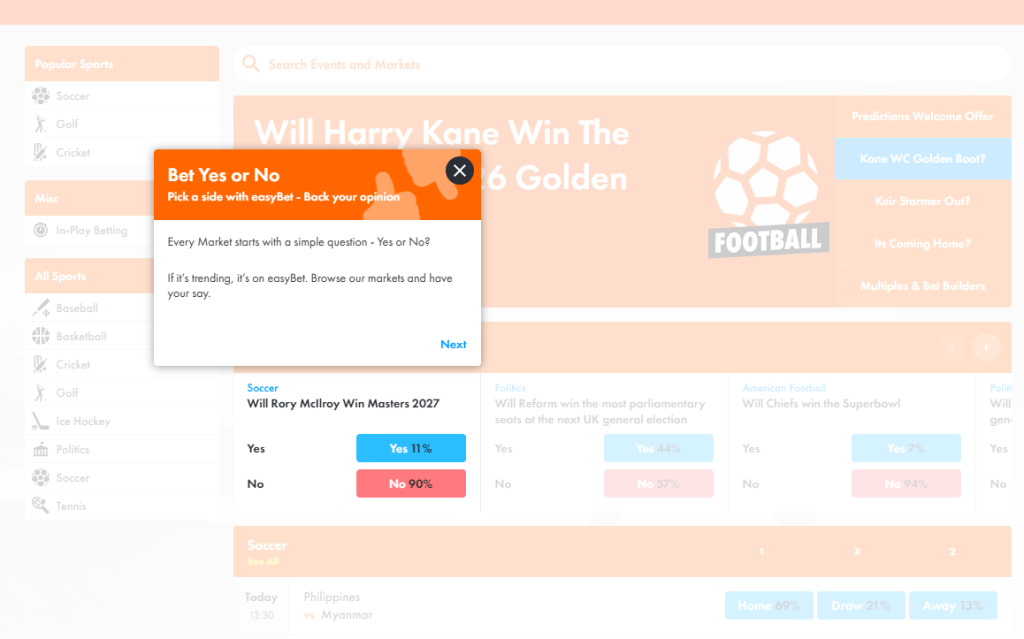
The pitch on the homepage is unusually clear by gambling industry standards: “Pick a side. Bet YES or NO on the biggest questions in sport, politics, and culture.”
That’s the entire product, more or less. easyBet Predictions takes any forecastable outcome — a football result, a tennis title, a general election seat count, a Super Bowl winner, a Golden Boot leader — and converts it into a binary question with two clickable answers. Each answer carries a percentage between 1% and 99%, representing the market’s current belief that the outcome will (or won’t) occur.
A few live examples pulled this afternoon:
- Will Rory McIlroy win The Masters 2027? — Yes 11%, No 90%
- Will Reform UK win the most parliamentary seats at the next general election? — Yes 44%, No 57%
- Will the Chiefs win the Super Bowl? — Yes 7%, No 94%
- Philippines vs Myanmar, today 13:30 — Home 69%, Draw 21%, Away 13%
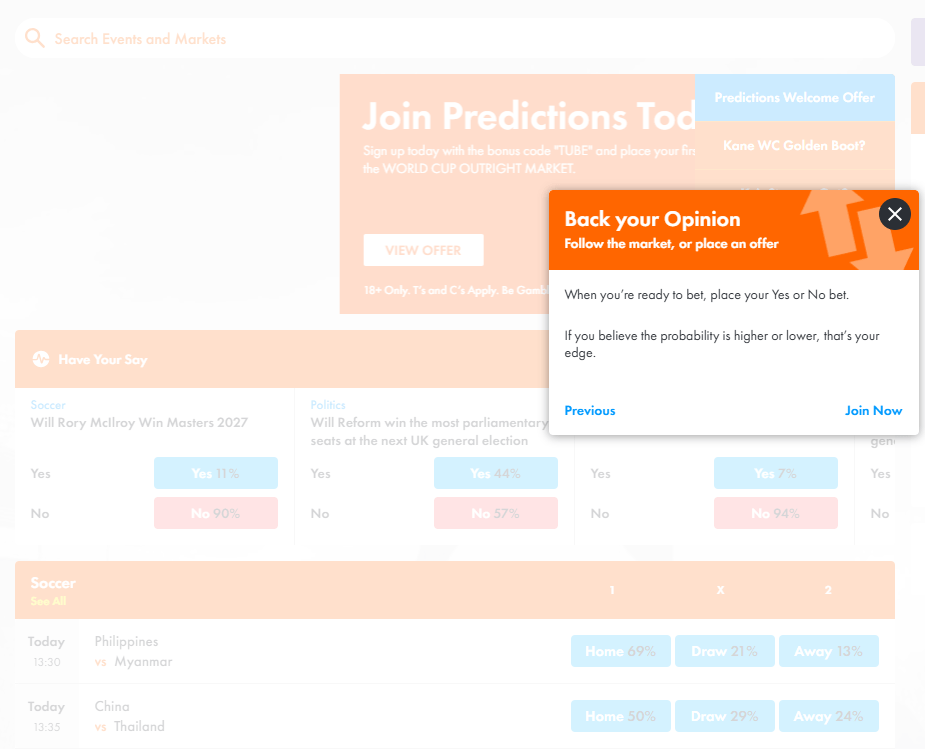
If you think Reform are more likely than the market does, you click Yes 44%. If you think the Chiefs are due, you click Yes 7%. The lower the percentage, the bigger the payout — which is the only real piece of explanation the platform offers, via a small tooltip: “Remember! The lower the %, the greater the payout if you’re right.”
For anyone who’s ever stared at 11/2 on a horse and quietly wondered whether that’s worse or better than 15/4, this is, frankly, a revolution in user experience.
Pick a side. Yes or No.
Every market is a question with two clickable answers. Percentages show how likely each outcome is — and the lower the percentage, the bigger the payout.
Football
Will Harry Kane win the 2026 World Cup Golden Boot?
Politics
Will Reform UK win the most parliamentary seats next election?
Golf
Will Rory McIlroy win The Masters 2027?
American Football
Will the Chiefs win the next Super Bowl?
Odds as a percentage
Prices run from 1% to 99% — reflecting the market’s collective belief in each outcome. The lower the %, the bigger the payout if you’re right. A bet on Yes at 11% pays roughly 9x your stake if it lands; a bet at 88% pays a smaller premium for being more likely.
Why Now? The Prediction Markets Surge
To understand why a British bookmaker is launching a Yes/No product in 2026, you have to understand what happened in 2024.
The breakout star of last year’s US presidential election wasn’t a pundit or a polling firm — it was Polymarket, a cryptocurrency-based prediction market that, at its peak, had over $2 billion wagered on whether Donald Trump or Kamala Harris would win. Polymarket’s price chart became the most-screenshotted election graphic on social media, beating out Nate Silver’s models and the Associated Press maps for cultural reach.
That same year, Kalshi — the only federally regulated US prediction market — won a Court of Appeals ruling allowing it to offer election contracts on its platform legally, putting prediction markets on the same regulatory footing as derivatives. By early 2026, Kalshi had broadened into sports, entertainment, and economic indicators. Robinhood, the retail-trading app, launched its own event contracts product. DraftKings and FanDuel, the two biggest US sportsbooks, both publicly confirmed they were exploring prediction-style integrations.
The trend wasn’t subtle. Casual users — people who’d never read a betting slip in their lives — were placing wagers on whether the Federal Reserve would cut rates, whether Wicked would beat Avatar at the box office, whether Taylor Swift would announce an engagement. Predictions, it turned out, were just questions, and questions were a format people understood.
In the UK, bookmakers, such as Smarkets and Betfair have run exchange-based betting for over a decade, and Betfair specifically has offered politically-tinged markets (general elections, party leadership contests) for years. But the format remained niche — gambling-adjacent rather than gambling-adjacent-for-normal-people. The percentages were buried in spread sheets of decimal odds. The exchanges felt like trading platforms, not entertainment.
What’s different about easyBet Predictions — and what’s interesting about the broader product trend it represents — is that the consumer interface has finally been simplified to match what casual bettors actually want: two buttons and a probability.

Why Bookmakers Are Quietly Pivoting
The British gambling industry has spent the last five years dealing with a structural problem most operators won’t say out loud: traditional fractional odds are a barrier to entry.
A 2023 internal study at one major UK bookmaker (which we can’t name, but which you’ve definitely used) found that users who failed to convert from sign-up to first bet most commonly listed “I don’t understand the odds” as the reason. Decimal odds helped marginally. Implied probability calculators on betting slips helped a bit more. But the friction was real, and the audience it locked out was huge: people who follow sport casually, people who watch a final once a year, people who’d happily put a tenner on a question but couldn’t be bothered to learn the difference between 5/2 and 5/4.
Prediction markets bypass this entirely. “Will X happen — Yes or No?” is a sentence anyone can parse. The percentage is intuitive in a way fractional odds never were: 12% sounds small, 73% sounds likely, 50/50 is a coin flip. There’s no Punter Maths required.
easyBet aren’t the first to spot this, but they may be the first British-licensed bookmaker to launch a properly consumer-facing version. Their Predictions product sits alongside their traditional sportsbook, exchange (where users can back, lay and trade in the same way Betfair’s exchange works), and bet builder — but the headline product, the thing the homepage now leads with, is the binary question format. That’s a deliberate choice. They’re betting that the next million British bettors won’t come in through the football coupon. They’ll come in through “Will Reform win the most seats?”
How easyBet Predictions Works (In Practice)
The product runs on what’s effectively a peer-to-peer exchange structure, similar to Betfair or Smarkets — but with the interface simplified down to two outcomes. Here’s the flow:
- Browse markets — Sport, Politics, Culture, In-Play. Each market is a question with two outcomes (Yes/No) or, for football match results, three (Home/Draw/Away).
- Pick a side — Click Yes or No. Your stake gets matched against the opposite side of the market.
- Watch the percentage move — As more money flows in on either side, the implied probability updates in real time. A “12% Yes” market can drift to “20% Yes” if news breaks.
- Trade out, or hold — You can sell your position back to the market at any time before the event settles (this is the “Back, Lay, Trade” feature borrowed from Betfair-style exchanges). Or you can hold to settlement and either win or lose.
- Settlement — Once the question is answered, winning positions pay out automatically based on the percentage you took. Lower percentages = bigger payouts.
For users who prefer building accumulators, easyBet have integrated best-priced multiples and bet builders into the same product. Three Yes-positions in a row at 30% each combine into a single multiple at the kind of price that would be hard to extract from a traditional sportsbook coupon.
The whole thing runs in the browser. There’s no separate Predictions app — it’s a section inside the main easyBet platform. The UI uses a soft coral-and-cream colour scheme that visually distances itself from the green-felt-and-leather aesthetic of traditional sportsbooks. The branding choice is intentional: this is a product for people who’d never describe themselves as gamblers.
£30 Welcome Offer at EasyBet — Promo Code PREDICTS
For new customers, easyBet are running a welcome offer specifically tied to the Predictions product, and British Gambler readers have access via our exclusive bonus code.
British Gambler Exclusive · easyBet Predictions
Get up to £30 Back as a Free Bet If Your Prediction Loses
- Sign up at easybet.net using code PREDICTS
- Place your first Yes or No prediction on any market
- If your selection loses, get your stake back as a Free Predictions Bet up to £30
- Free bet credited within 24 hours · 7-day expiry · stake not returned with winnings
- Maximum free bet £30 — stake your first bet at £30 to claim the full amount
18+ · New customers only · UK only · UKGC licensed · GambleAware.org · T&Cs apply
The mechanic is genuinely simple — sign up using code PREDICTS, place your first Yes/No prediction on any easyBet market, and if it loses, you get your stake back as a Free Predictions Bet, up to £30. There’s no minimum odds restriction, no qualifying multi-bet structure, no obscure wagering requirement. You bet, and if you lose, you bet again on the house.
A few small print points worth knowing before you sign up:
- The free bet is paid as a Predictions Bet — usable on the Yes/No markets, not the traditional sportsbook
- The free bet stake isn’t returned with winnings (standard for free bets)
- 7-day expiry from credit
- Maximum free bet value £30
- One per household
- 18+, UKGC licensed via easyBet’s Gibraltar regulatory framework, T&Cs apply
For the maximum £30 free bet, your first prediction needs to be a £30 stake. Smaller first bets give you proportionally smaller refunds (a £10 first bet that loses returns £10 as a free bet).
A Note: easybet.net vs easybet.com
One thing British Gambler thinks readers need to know before signing up: the official easyBet site is easybet.net, not easybet.com.
This matters because easybet.com is an affiliate site that lists offshore bookmakers — a different operation entirely, unrelated to the UK-facing easyBet bookmaker we’re covering here. The two are easily confused because of the near-identical URLs, but the regulatory situation is completely different:
- easybet.net — the official UK-facing easyBet bookmaker, properly licensed, the platform offering Predictions and the £30 PREDICTS welcome offer
- easybet.com — a third-party affiliate marketing site, not the official bookmaker, and the bookies it lists may not be UK-regulated
If you’re going to sign up for the Predictions product, make sure you’re at easybet.net, or follow our affiliate link below — which routes through the verified official platform.
What’s Next: Prediction Markets in Britain’s 2026
easyBet aren’t the only ones moving on this. Smarkets have spent the last year reshaping their interface to look less like a financial trading screen and more like a consumer product, recently adding a politics section that runs prediction-market-style cards with Yes/No outcomes and percentage prices. Betfair, the original UK exchange, has been quietly expanding its non-sports market coverage, with Eurovision, Strictly Come Dancing result markets, and reality TV winner markets that look indistinguishable from the Polymarket format. Even Sky Bet are rumoured to be testing a Yes/No section in private beta for autumn 2026.
The broader bet is that the British gambling industry, having spent twenty years optimising for serious punters who could decode odds and parlay systems, is finally building for the audience it never quite reached: the casual viewer who watches a final once a year, the office sweepstake organiser, the politically interested viewer who’d never bet on a horse but might bet on whether Keir Starmer survives another year as PM.
Whether easyBet’s specific implementation wins the race or gets out-competed by Smarkets’ deeper exchange liquidity is anyone’s guess. But the format itself — Yes, No, percentages — is now mainstream. The maths is, finally, being stripped away.
If you’ve been curious about gambling but found the entire vocabulary impenetrable, this is the product to try. And the £30 welcome offer makes it free to find out whether the format clicks for you.
Claim £30 Free Bet at easyBet →
18+ UK only. New customers only. Use bonus code PREDICTS at sign-up at EasyBet Predictions. Max free bet £30. T&Cs apply. UKGC licensed via easybet.net. When the fun stops, stop. GambleAware.org · 0808 8020 133. British Gambler may earn commission from links on this page at no extra cost to you.