



On 26 February 2026, Tim Miller of the UKGC told the BGC Annual General Meeting that cryptoasset payments at licensed gambling operators were under exploratory review. The reasoning is the offshore market, and the position is more nuanced than either the libertarian or the prohibitionist camp has acknowledged.
The UK Gambling Commission’s posture on cryptocurrency at licensed gambling operators has, until recently, been a polite refusal to engage. Crypto was not a permitted payment method at UKGC-licensed online casinos and sportsbooks. The official line was that crypto did not fit cleanly within the source-of-funds checks and anti-money-laundering controls required of regulated operators. The status quo was stable. (A useful comparison case is the parallel regulatory grey area covered in our explainer on whether sweepstakes casinos are regulated — a different product, but the same underlying tension between a legal alternative payment / prize structure and the UK regulator’s preference for clear oversight.)
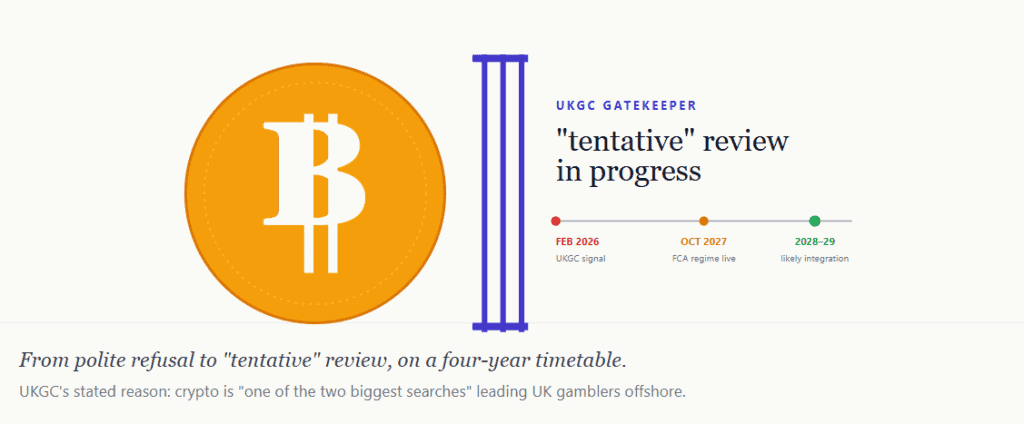
On 26 February 2026, that stability ended. Executive director Tim Miller, speaking at the Betting and Gaming Council’s Annual General Meeting in London, announced that the Commission had asked its Industry Forum to examine what a “sensible” pathway might look like for crypto to be used as a consumer payment option at licensed and regulated gambling operators in Great Britain.
The announcement is pre-consultation. No formal consultation paper has been issued, and no amendment to the Licence Conditions and Codes of Practice has been proposed. Miller characterised the work as “tentative” and “exploratory.” But the speech was the first time a senior UKGC figure had publicly stated that the answer to crypto at licensed UK operators was not a permanent “no.”
Why now, why this way, and whether the answer should ultimately be yes — those are the live questions.
What changed
Two things changed in the six months before Miller’s speech.
The first is the regulatory architecture. In December 2025, the UK government laid the Financial Services and Markets Act 2000 (Cryptoassets) Regulations 2025 before Parliament. The legislation, if approved, brings cryptoasset activities within the remit of the Financial Conduct Authority. The new regime is expected to take effect on 25 October 2027. Firms wishing to undertake regulated cryptoasset activities will require FCA authorisation under FSMA with specific permissions. The application window opens 30 September 2026 and closes 28 February 2027.
This is the structural shift that the UKGC has been waiting for. The Commission’s previous concern about crypto was that no UK regulatory body had clear oversight over crypto firms — meaning that a UKGC-licensed gambling operator accepting crypto deposits would be relying on counterparty crypto firms operating outside the UK regulatory perimeter. With the FCA stepping into that role, the structural objection falls away. The supervisory chain — UKGC oversight of the operator, FCA oversight of the crypto firm handling deposits — becomes complete.
The second is the offshore market. Miller said explicitly during his speech that the Commission’s research had identified crypto as “one of the two biggest searches” leading British gamblers to unlicensed offshore operators. That single data point is the reasoning behind the entire pivot. UK players who want to gamble with crypto cannot do so at UK-licensed operators. They can — and demonstrably do — do so at offshore operators that accept crypto. Every UK player who searches for “Bitcoin casino UK” or related terms like crash gambling, which we cover in detail elsewhere, is currently being directed, by Google’s search results, away from the UKGC-licensed sector.
The Commission’s calculation is that bringing crypto inside the regulated perimeter is harm reduction. The alternative — refusing to engage — has produced a documented migration of players to platforms with no consumer protections at all, the trajectory we analysed at length in our shock-therapy opinion piece.
The libertarian argument
The libertarian position on UK crypto gambling regulation is straightforward. Cryptocurrency is a legal payment method. Gambling with cryptocurrency at appropriately regulated operators is a legal activity in jurisdictions including Malta, the Isle of Man (in non-UK-facing capacity), and several US states. UK adults make informed decisions about how they spend their own money. The state’s role is to ensure operators are honest, the games are fair, and the consumer protections are in place. The choice of payment method is the player’s.
On this argument, the UKGC’s previous refusal to permit crypto was paternalism dressed up as consumer protection. The 2027 FCA regime addresses the legitimate concerns about counterparty risk. The lasting objection — that crypto enables money laundering — is partially addressed by FCA authorisation requirements but more fundamentally addressed by the fact that the same UK casinos already conduct source-of-funds checks regardless of payment method. A crypto deposit into a UKGC-licensed account is no more anonymous than a bank transfer, because the operator runs the same checks against the player’s identity in both cases.
The prohibitionist argument
The prohibitionist position is also internally consistent. Cryptocurrency is significantly more volatile than fiat currency. A player depositing £200 worth of Bitcoin is depositing an amount that, at the volatility levels typical of major cryptocurrencies, may be worth £150 or £250 by the time they actually wager it. This introduces an additional layer of risk that has no equivalent in cash-denominated gambling.
Cryptocurrency also has a documented association with problem gambling subgroups. Research from the GambleAware-funded studies and the broader academic literature has indicated that crypto gambling overlaps significantly with high-risk gambling behaviour — partly because the demographics that adopt crypto early skew younger and more risk-tolerant, and partly because the crypto-gambling overlap has historically been concentrated in offshore operators with weaker consumer protections, which selects for higher-risk players.
The prohibitionist argument is that bringing crypto into the regulated UK market does not necessarily reduce harm — it may simply legitimise a payment method that introduces additional volatility risk and that is associated with elevated harm rates in observed populations. The right response is to maintain the existing prohibition, accept that some players will migrate to offshore alternatives, and focus enforcement on those alternatives.
What the evidence actually supports
Neither position is fully supported by the available evidence, because the available evidence is limited.
What is documented:
- UK player demand for crypto gambling is real and is currently being met by offshore operators with no consumer protections.
- The 2027 FCA regime closes the most substantive structural objection to crypto at UKGC-licensed operators.
- Other regulated markets — notably Malta — have permitted crypto at MGA-licensed operators without producing documented spikes in problem gambling rates that diverge from the broader trend.
- The cumulative direction of UK gambling regulation since 2023 has been towards consumer protection through regulation rather than prohibition.
What is not documented:
- Whether permitting crypto at UKGC-licensed operators would meaningfully reduce migration to offshore platforms, or whether the offshore appeal is the broader proposition (no affordability checks, no stake limits, higher RTP) rather than crypto specifically.
- The size of the population of UK players who are currently choosing offshore specifically for crypto payment, as opposed to other reasons.
- Whether crypto payments at licensed operators would attract new players to gambling who would not otherwise gamble, particularly younger players who are crypto-native and gambling-curious.
The likely outcome
The probable trajectory is a slow, conditional approval over the period from 2027 (when the FCA regime takes effect) through 2028-2029. Implementation will likely require operators accepting crypto to:
- Hold FCA authorisation for the relevant cryptoasset activities.
- Apply the existing UKGC source-of-funds and KYC checks, with crypto-specific provisions for tracing the origin of deposited cryptocurrency.
- Convert deposited crypto to GBP at the point of deposit for accounting purposes, removing the volatility-during-play issue.
- Apply additional disclosure to players about crypto-specific risks at the deposit interface.
- Be subject to specific monitoring for crypto-related problem gambling patterns under the same algorithmic surveillance framework now required across all licensed operators.
This is, by international standards, a moderate framework. It is more restrictive than Malta’s, less restrictive than the US states that have permitted crypto gambling. It positions the UK as a follower rather than a leader on the international crypto-gambling regulatory question — which, given the Commission’s existing reputation for cautious leadership, is probably the correct posture.
What it means for British players
In the short term, nothing changes. Crypto remains unavailable at UKGC-licensed operators through at least 2027, and any expansion of permitted payment methods will be slow and conditional. UK players who want to gamble with cryptocurrency will continue to face the choice between the UKGC-licensed sector (no crypto, full consumer protections) and the offshore sector (crypto available, no consumer protections).
The advice for British players, throughout this transition, is the same advice that applies regardless of payment method preferences: a UKGC-licensed operator with the affordability framework, the statutory levy contribution, the algorithmic player protection, and the formal complaints route is a structurally safer environment than an offshore alternative, even if that offshore alternative offers a payment method the UK market does not yet support.
The Commission appears to understand that the long-term answer is to bring crypto inside the regulated perimeter rather than to keep refusing to engage. The question through 2027-2028 is the pace and conditions of that integration. Whatever the outcome, the strategic shift Miller signalled in February 2026 was the first significant evolution in UKGC posture on this question since cryptocurrency became commercially relevant to gambling, and it deserves more public attention than it has received outside the trade press.
UKGC-licensed gambling operators with the most extensive supported payment methods — until crypto arrives, Trustly casinos remain the closest equivalent on speed and bank-direct deposits
Sources we used:
- Tim Miller speech at BGC AGM, 26 February 2026 (official UKGC publication)
- Financial Services and Markets Act 2000 (Cryptoassets) Regulations 2025
- FCA cryptoasset authorisation framework publications (2025-2026)
- CoinDesk, Yogonet, Finance Magnates coverage of UKGC crypto pivot (February-March 2026)
- Prokopiev Law regulatory commentary (March 2026)
- Malta Gaming Authority cryptoasset operator framework
- GambleAware research on crypto-gambling overlap