


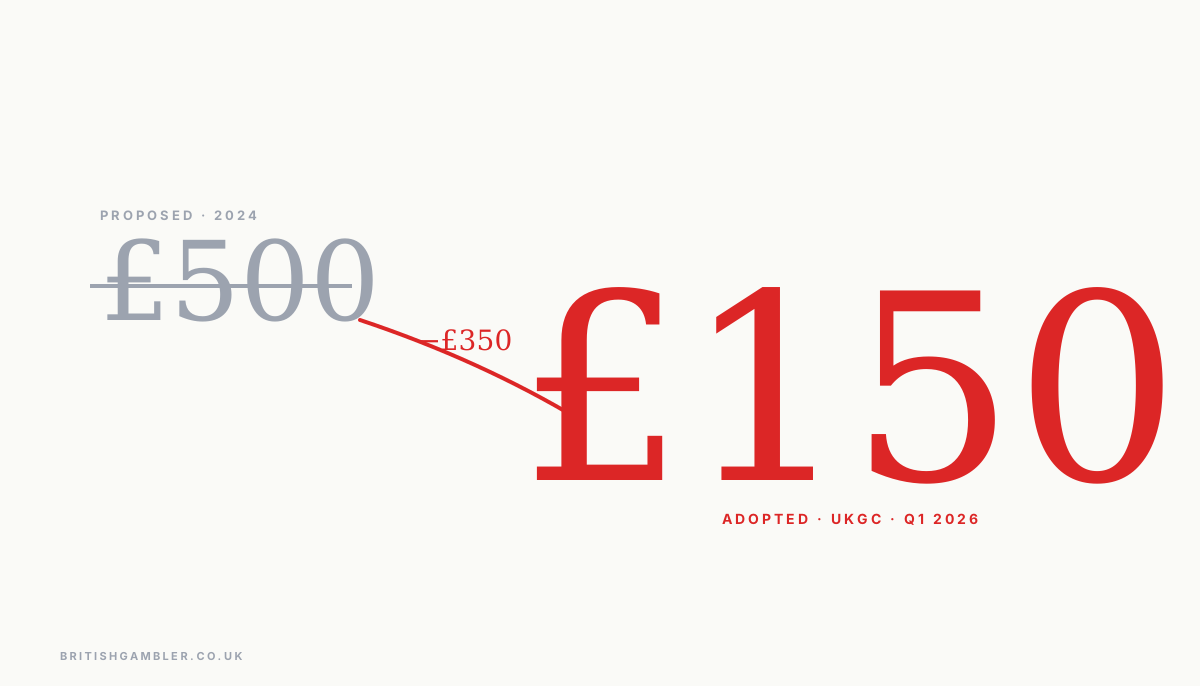
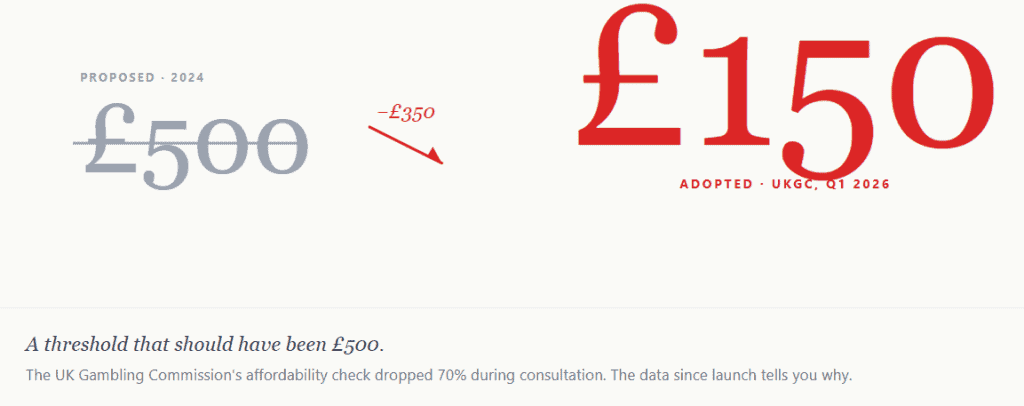
When the Gambling Commission set the trigger point for “frictionless” financial risk checks at a £150 monthly net loss, it picked a number that had not been in the original White Paper consultation. The proposed figure was £500. It was reduced to £150 during a six-month consultation in 2025, and the Betting and Gaming Council, the Racecourse Association and several major operators publicly objected. The Commission rolled out anyway in Q1 2026.
Six months of data later, the case for £150 is weaker than the case against it.
The maths the BGC keeps pointing at
The £150 figure represents roughly a fiver a day. For a recreational sports bettor staking £25 on a weekend football accumulator and losing it, you reach the threshold inside a calendar month with no aggressive behaviour at all. For an online slots player on a £20 deposit using a 96% RTP game, theoretical loss across a few sessions clears the line comfortably.
The Commission’s defence is that the first tier of the framework is invisible: the credit reference check runs in the background using data already held by Experian, Equifax and TransUnion, and approximately 95% of Stage 1 checks during the pilot resolved with no interruption to the player’s experience. That is the figure UKGC has used repeatedly in public communications, including a May 2026 statement directly responding to operator concerns.
The problem is what happens to the other 5%. That fraction translates to documentary requests — bank statements, pay slips, evidence of source of funds — for players who, in many cases, are losing modest amounts by any rational definition of “modest.” A regulated bookmaker who interrupts a £35 weekend football bettor and asks for a P60 has not protected that customer; it has reinforced the perception, now well-documented in player surveys, that UK-licensed sites are slower and more obstructive than the offshore alternatives. They have sent them to a Curaçao-licensed alternative on Instagram.
What the economic modelling actually showed
The most rigorous economic modelling on the White Paper reforms is the National Institute of Economic and Social Research (NIESR) analysis, produced in collaboration with the University of Glasgow and titled <em>The Macroeconomic Impact of Reducing Gross Gambling Yield: An Empirically-Informed Model</em>. The research estimated a roughly £812 million reduction in Gross Gambling Yield from the reform package. Of that, NIESR concluded, only around £134 million — approximately 16% — would translate into a net negative impact on UK GDP. The remainder, in NIESR’s modelling, would be reallocated into other consumer spending and increased savings rather than disappearing from the economy.
That 16% figure is what regulators cite when defending the reforms on cost-benefit grounds. It also tells you, by elimination, that 84% of the projected GGY reduction is expected to relocate rather than disappear. NIESR’s modelling treated this as redirected to other consumer spending and savings. The honest follow-up question is what happens when the relocation runs in a less benign direction.
The black market answers it
H2 Gambling Capital data commissioned by the BGC and published in spring 2026 shows offshore betting volume rising from approximately £5 billion in 2019 to £16.6 billion in 2025 — the trajectory examined in detail in our opinion piece on UK gambling’s “shock therapy” and the bigger black market. The largest acceleration occurred between 2023 and 2025, with both stakes and operator profits doubling. Separate analysis by fraud specialist Alex Wood for Flutter UK & Ireland, published ahead of the 2026 Cheltenham Festival, found that offshore platforms pass basic identity checks with obviously false personal details. Instagram tipster accounts funnel users toward unlicensed operators with no friction.
Yield Sec’s research, commissioned by the Campaign for Fairer Gambling, puts unlicensed operators at 9% of the UK online market and £379 million in extracted gross gambling revenue in the first half of 2025 alone. The trajectory: 0.5% of UK gambling activity in 2020, 12-15% by 2025.
You can defend the £150 threshold as a harm-reduction measure. You cannot defend it as a harm-reduction measure that is reducing harm — not when 1.5 million British players are now estimated to be staking on unlicensed offshore sites and the regulated market is losing share month by month.
What the Commission is doing instead of admitting it
The UKGC’s public position remains that the frictionless tier works and that operator complaints are revenue-protection dressed up as consumer-protection concerns. That argument was viable in February 2026. By May, it was being repeated alongside an announcement that the regulator was recruiting a Head of Illegal Markets at a £65,000 salary, which industry observers have widely judged inadequate to the scale of the problem, and accepting £26 million in government funding over three years to expand enforcement against offshore operators. The Commission has also joined the DCMS Illegal Gambling Taskforce alongside Google, Mastercard, TikTok and Visa.
These are not the actions of a regulator confident that its policy framework is working. They are the actions of a regulator trying to plug a hole that its own policy framework opened.
What happens next
The Commission has indicated that Phase 2 of the financial risk assessment framework, expected in late 2026 or early 2027, may incorporate open banking data alongside credit reference data, producing a more accurate but potentially more intrusive check. Industry sources suggest the threshold may also be revisited.
The honest reform would be to revisit the threshold upward, not downward. £500 was the original proposed figure for a reason: it represented a level at which financial vulnerability genuinely correlates with sustained loss, rather than a level at which the average weekend football bettor is doing nothing more harmful than enjoying their hobby.
A regulator that genuinely believes its tools are working should be willing to defend them at the most generous threshold the evidence supports, not the most restrictive. The fact that the UKGC dropped to £150 during consultation, against industry warnings that have since been borne out by the data, is the closest thing to an admission that the affordability check framework is doing two things at once: protecting the most vulnerable, and pushing the most price-sensitive to the black market. The first is working. The second is not being acknowledged.
UK Betting Operators
List of 10 UKGC-licensed sites with smoothest affordability check experience based on user reports
-
1
Football · Horse Racing · Live StreamingGet Bonus
The UK’s highest-rated bookmaker. Launched 2000, owned by Denise Coates, with 45M+ users worldwide. UKGC #55148. Best-in-class odds value, 200+ markets, live streaming and the leading bet builder app in the UK market. Read review →
Bet £10 Get £30 in Free Bets365GMBLR18+ GambleAware.org. New bet365 customers only. Min deposit. Free Bets paid as Bet Credits, available on settlement of qualifying bets. Min odds, bet and payment exclusions apply. Returns exclude Bet Credits stake. Registration required. T&Cs apply. #ad
-
2
Football · Golf · Rugby · Greyhound RacingGet Bonus
Founded 1967 by Fred Done, with 1,600+ UK betting shops. The benchmark for golf, rugby and greyhound odds. Excellent custom bet tool and a generous £50 in bonuses (3×£10 sports free bets + 2×£10 acca free bets). Read review →
Bet £10 Get £50 in Bonuses18+ GambleAware.org. New customers only. Register, deposit with Debit Card, place first bet £10+ at Evens (2.0)+ on Sports within 7 days to get 3 × £10 in Sports Free Bets & 2 × £10 in Acca Free Bets within 10 hours of settlement. 7-day expiry. Eligibility & payment exclusions apply. T&Cs apply.
-
3
Football · US Sports · Live StreamingGet Bonus
Best UK bookmaker for the “Betway Boosts” feature — boosted selections across Champions League, Premier League and US sports give serious value if you research. £30 matched free bet if your first acca loses plus 50 Free Spins on Big Bass Bonanza. Read review →
£30 Free Bet + 50 Free Spins18+ GambleAware.org. New customers only. Place min £10 bet at min odds 2.0. £40 in Free Bet Tokens awarded as 4×£10. 7-day expiry. Debit Card deposits only (exclusions apply). T&Cs apply.
-
4
Football · Cricket · RugbyGet Bonus
Mobile-first UK bookmaker from the Smarkets exchange family. Famous for the live odds comparison feature — shows exactly where SBK’s prices sit against the wider market. Best for football, cricket and rugby. Read review →
Wager £20 Get £40 in Free Bets18+ GambleAware.org. New UK customers. Min £20 first deposit. Place a bet of £20 at min odds of 2/1 (3.0). Get £40 in Free Bets within 48 hours. Restrictions apply. T&Cs apply. #ad
-
5
Cricket · American Football · FootballGet Bonus
UK-licensed independent bookmaker (founded 1999) offering a unique blend of fixed odds and spread betting in one account. Best UK site for cricket and American football coverage. £60 free bets split across both products. Read review →
£60 in Free Bets (Fixed + Spread)18+ GambleAware.org. Spread betting losses can exceed deposit. Place £10 fixed odds single or £10 each-way bet at min odds 1/2 to get 3×£10 free fixed odds bets, 3×£5 Total Goals spread bets and 3×£5 Winning Favourites spread bets. Promo code optional. Full T&Cs apply.
-
6
Horse Racing · Football · 50,000+ MarketsGet Bonus
Launched 2016 by Rank Group with single-wallet integration across 50+ Grosvenor land-based casinos. Best UK site for horse racing betting. Unique “doubled odds on first bet” offer plus 50,000+ markets. Read review →
Bet £10 Get Doubled Odds18+ GambleAware.org. New customers. Min stake £10 at odds 1/2 (1.5)+. Three £10 free bet tokens applied on qualifying bet settlement. Country restrictions and T&Cs apply.
-
7
Football · Horse Racing · CashbackGet Bonus
UKGC-licensed bookmaker with the softest landing on the market: 50% of first day’s losses back as a Free Bet up to £25. Even if you finish up (or losses under £5), you still get a £5 Free Bet. Read review →
50% Back as Free Bet up to £2518+ GambleAware.org. New UK Customers Only. Bet £10+ on any sportsbook markets at odds of evens (2.00)+. No cash out. Get 50% back of first day’s losses as a Free Bet up to £25, valid 7 days. Min 3 bets on different events required. T&Cs apply.
-
8
Football · Bet Builder · MultiplesUse Code
Newer UK-licensed bookmaker with a deliberately simple sign-up flow and clear bonus structure. Bet £20 across 2+ events at odds 2.0+ on singles, multiples or bet builders to unlock £20 in free bets. Best fit for casual punters. Read review →
Bet £20 Get £20 BonusEB2018+ GambleAware.org. New easyBet customers only. Min £20 across 2+ different events at odds 2.0+. Singles, multiples or Bet Builders. T&Cs apply.
-
9
Football · Bet Builder · AccaGet Bonus
Major European brand with full UKGC licensing. Free bet split into 2×£10 Bet Builder + £10 Accumulator — useful if you actually use bet builders rather than singles. Deposit and instant bank transfers only on the welcome offer. Read review →
Bet £10 Get £30 in Free Bets18+ GambleAware.org. New GB customers only. Opt in. Deposit and Bet £10+ at min odds 2.0+ for £30 in Free Bets within 7 days. Debit cards or instant bank transfers only. 7-day expiry. T&Cs apply. #ad
-
10
Football · Horse Racing · CashbackGet Bonus
Independent UK-licensed boutique bookmaker. Headline differentiator: a permanent 10% cashback on net losses, not just a one-off welcome offer. Best fit for regular punters who want a softer long-term loss structure. Read review →
Always 10% Cashback on Losses18+ GambleAware.org. New players only. Minimum deposit and bet required for cashback bonus. Eligibility and game weighting apply. T&Cs apply.





18+. GambleAware.org. All bookmakers listed hold a UK Gambling Commission licence. New customer offers — T&Cs apply, full terms via each site’s link. Please gamble responsibly.
Sources that we cited:
- UK Gambling Commission, public statements on FRA rollout (April-May 2026)
- BGC / H2 Gambling Capital research (spring 2026)
- Yield Sec report commissioned by Campaign for Fairer Gambling (March 2026)
- Flutter UK & Ireland / Alex Wood report (April 2026)
- SBC News economic modelling coverage (May 2026); NIESR / University of Glasgow paper “The Macroeconomic Impact of Reducing Gross Gambling Yield: An Empirically-Informed Model”
- DCMS Illegal Gambling Taskforce announcement