


Ask an occasional punter to read 11/4 or even 3.75, and you will often get a blank look. Ask them “Will England win the World Cup — yes or no, and how likely is it?” and they will answer instantly. That gap is the entire reason prediction markets have crossed the Atlantic. In the United States they have become a phenomenon — roughly £32.8 billion ($44 billion) was traded on prediction markets in 2025, with more than $1.5 billion staked on the 2026 World Cup winner alone. Now, in 2026, the format has arrived in Britain under full Gambling Commission regulation. This guide explains what prediction markets are, how the Yes/No trading actually works, whether they are genuinely different from a betting exchange, and which UK sites are worth knowing.
The US boom — and why the UK is different
America’s prediction-market surge was powered by a regulatory quirk. Platforms such as Kalshi and Polymarket are overseen by the Commodity Futures Trading Commission (CFTC) as financial “event contracts,” which lets them operate nationally and sidestep the patchwork of state gambling laws. Wrapped in a fintech aesthetic — order books, probabilities, “trading” rather than “betting” — they pulled in a young, finance-literate audience that traditional sportsbooks never reached.
Britain is taking a different road. Here, prediction markets sit inside gambling regulation, not financial-derivatives law, so they launch under existing UK Gambling Commission licences. That means the most exotic US-style menus — betting on every political and current-affairs twist — will be more tightly limited in the UK. But the core appeal travels intact: a simpler, friendlier way to back an opinion.
What is a prediction market, and how does it work?
A prediction market lets you trade simple Yes/No contracts on the outcome of a real-world event, at a price that represents its probability.
- A price of 20% (or £0.20 a share) means the market thinks there’s a 20% chance of that outcome.
- If you’re right, each share settles at £1 (100%); if you’re wrong, it settles at £0.
- You can also sell (back the “No”), and you can usually trade out before the event finishes as the price moves.
Worked example: “Will England win the World Cup?” trades at 20% for Yes. You buy £20 of Yes shares at £0.20 each — 100 shares. If England win, your shares settle at £1 each: £100 back (an £80 profit). If they don’t, the shares are worth nothing and you lose your £20. Buying “No” at 80% would profit if England fail. It is the same risk as a bet — just expressed as a probability you can read at a glance.
Betting exchange vs prediction market: are they the same thing?
This is the question everyone in the industry is asking, and the honest answer is: in the UK, mechanically, they are almost the same — and the difference is mostly presentation, branding and marketing.
Both are peer-to-peer: you trade against other users, not against a bookmaker, and the operator takes a small commission. The man launching the UK’s first dedicated product, Matchbook’s chief executive, put it plainly — it runs on the same exchange engine, and the differences are “presentation and product nuances rather than a new core engine.”
Where they genuinely diverge:
- The interface. A betting exchange shows back/lay prices in decimal odds (e.g. 5.0). A prediction market shows Yes/No at a percentage probability (e.g. 20%). Backing at 5.0 is the same position as buying “Yes” at 20%; laying is the same as buying “No.”
- The marketing. Exchanges talk “betting”; prediction markets talk “trading” and “forecasting” — deliberately appealing to people who find a betting slip off-putting.
- The regulation (US only). In America, prediction markets use a derivatives wrapper to escape state gambling law. In the UK both are simply gambling, licensed by the Commission — so that distinction disappears here.
Our verdict: in Britain, a prediction market is best understood as a betting exchange with a clearer, probability-first interface aimed at a new audience. Not a brand-new product — but a meaningfully better experience for the casual user.
TOP UK prediction-market sites to know
All of the genuine UK options currently run on Matchbook’s exchange under Triplebet’s UK Gambling Commission licence — making it the only platform in the world hosting several licensed prediction-market brands at once.
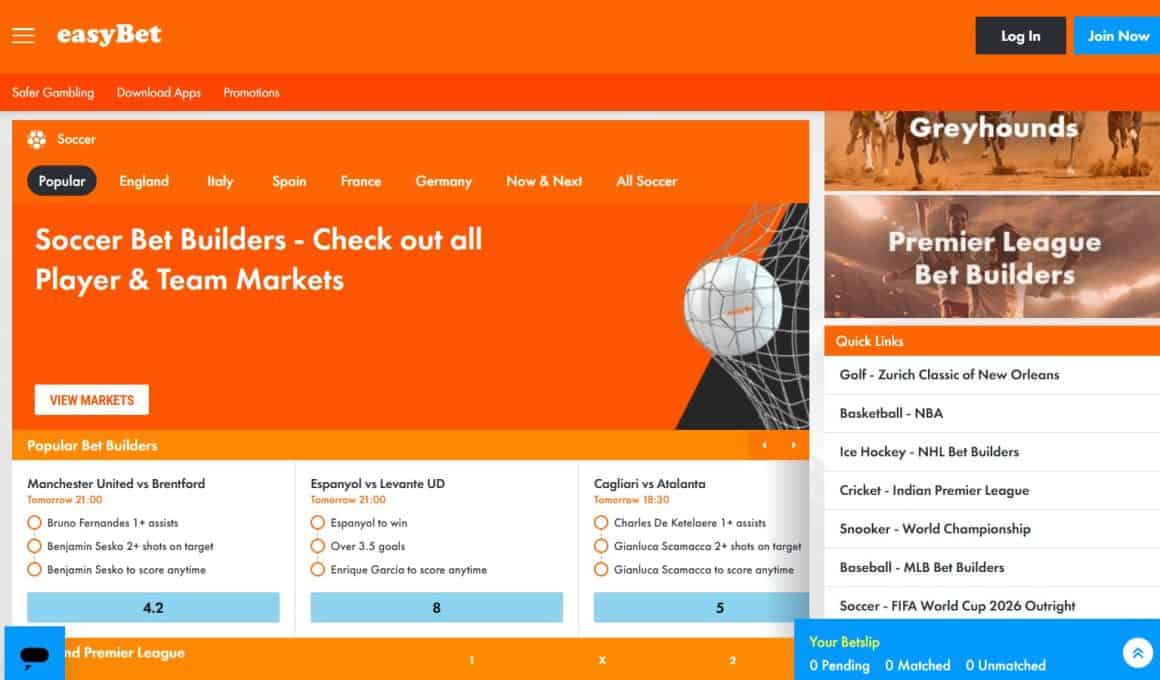
- easyBet Predictions — the UK’s first consumer-facing prediction market, part of Sir Stelios Haji-Ioannou’s easyBet. It swapped its traditional sportsbook for a clean Yes/No interface (blue for Yes, red for No), squarely targeting newcomers who never warmed to odds. (See our easyBet review.)
- Matchbook Predictions — the exchange’s own product, launched in January 2026 as the UK’s first dedicated prediction market. It pairs nearly two decades of exchange liquidity and low commission with a simpler probability interface, focused on sports plus a limited set of UK markets.
- ADI Predictstreet (at Matchbook) — the official prediction-market partner of the 2026 FIFA World Cup, offering tournament-winner, top-scorer, group and in-play markets, with live streaming of all 104 matches. Sports-only, and live in the UK from June 2026.
- The exchanges next door — Betfair is testing its own prediction product, and Smarkets/SBK already offer exchange-style trading that is a short step from the Yes/No format. Expect more UK names to follow.
The US giants — for context, not for UK play
You will see these named everywhere, so it’s worth knowing them — but a clear warning first: Kalshi and Polymarket are not licensed or available to UK customers. They require a US address, and we don’t recommend or link to them for UK players.
- Polymarket — a crypto-based (USDC) prediction exchange, now CFTC-regulated in the US. Its headline promo is a deposit $20, get $50 trading-credit bonus (US only), and its 2026 referral programme pays existing high-volume traders a share of their referrals’ trading fees rather than a flat bounty.
- Kalshi — a CFTC-regulated exchange offering a modest sign-up bonus (around $20) and a referral scheme worth up to $1,000. US only.
We mention these to explain the global picture. For UK players, stick to UKGC-licensed options.
Types of markets you can trade
- Sports — match and tournament winners, top scorer, group outcomes, and in-play markets. This is the heart of the UK offering (ADI Predictstreet is sports-only).
- Politics and current affairs — enormous in the US, but deliberately limited in the UK, where operators are cautious about integrity and compliance.
- Entertainment — awards, TV and novelty outcomes.
- Economics, weather and crypto — common on US platforms, rare under UK gambling rules.
Bonuses and offers
UK-licensed prediction markets tend to reward you with commission-free trading rather than free bets — a better fit for an exchange model. Always confirm current terms on the operator’s site.
UK-available (UKGC-licensed):
| Site | Type | Typical welcome |
|---|---|---|
| easyBet Predictions | Prediction market | Bet £20, get £20 (verify current) |
| Matchbook Predictions | Exchange + prediction | 0% commission intro period |
| ADI Predictstreet (at Matchbook) | Prediction market | World Cup hub + live streaming |
| Betfair Exchange | Exchange (prediction beta) | Exchange welcome (varies) |
Why this matters for occasional gamblers and the next generation
Prediction markets are aimed squarely at the people traditional betting leaves behind:
- No odds to decode. “22% chance” is something everyone understands; 11/4 is not. That alone lowers the barrier for occasional and first-time bettors.
- It feels like an app, not a betting shop. The fintech, “trading” framing suits a younger generation comfortable with stocks and crypto but wary of a bookmaker.
- Transparent pricing. Because prices are set by supply and demand, you can see the market’s genuine view — and how much margin a traditional fixed-odds price was hiding.
Our opinion
In our view, prediction markets are not the revolution the headlines suggest — under the bonnet they are exchanges, and UK punters have had exchanges for two decades. But the interface is a real leap, and that matters more than the purists admit: making probability legible could bring a whole new audience into regulated, UKGC-licensed betting rather than pushing them toward unlicensed crypto platforms. The risks are the same as any betting, and the simplicity cuts both ways — “yes or no” can feel deceptively easy. Treat it as gambling, because in Britain that is exactly what it is. But as a clearer, fairer-feeling way in, it’s the most interesting thing to happen to UK betting in years.
FAQs
What is a prediction market? A platform where you trade Yes/No contracts on real-world events at a price equal to the outcome’s probability. Correct contracts settle at £1 (100%); wrong ones at £0. You can usually trade out before the event ends.
Are prediction markets legal in the UK? Yes — when run by a UK Gambling Commission-licensed operator. UK prediction markets (easyBet Predictions, Matchbook Predictions, ADI Predictstreet) are regulated as gambling. Polymarket and Kalshi are US platforms and are not available to UK customers.
Is a prediction market the same as a betting exchange? Mechanically, in the UK, they’re very close — both are peer-to-peer with the operator taking commission. The main differences are the interface (Yes/No probabilities vs back/lay decimal odds) and the marketing. In the US there’s also a regulatory difference (derivatives vs gambling).
How is a 20% price the same as odds of 5.0? A 20% probability implies a 1-in-5 chance, which is decimal odds of 5.0 (or 4/1 fractional). Buying “Yes” at 20% is the same position as backing at 5.0 on an exchange.
Can I use Polymarket or Kalshi in the UK? No. Both require a US residential address and are not licensed for UK customers. UK players should stick to UKGC-licensed prediction markets.
Why are prediction markets popular with younger and occasional bettors? Because a probability is far easier to read than fractional or decimal odds, and the “trading” interface feels like a fintech app rather than a betting shop — lowering the barrier for newcomers.