


 Jak Netting
Fact-checked by British Gambler
Spotted a mistake? Email
partners@britishgambler.co.uk
Jak Netting
Fact-checked by British Gambler
Spotted a mistake? Email
partners@britishgambler.co.uk
Gambling sponsors have become an increasingly talked-about and controversial topic in football.
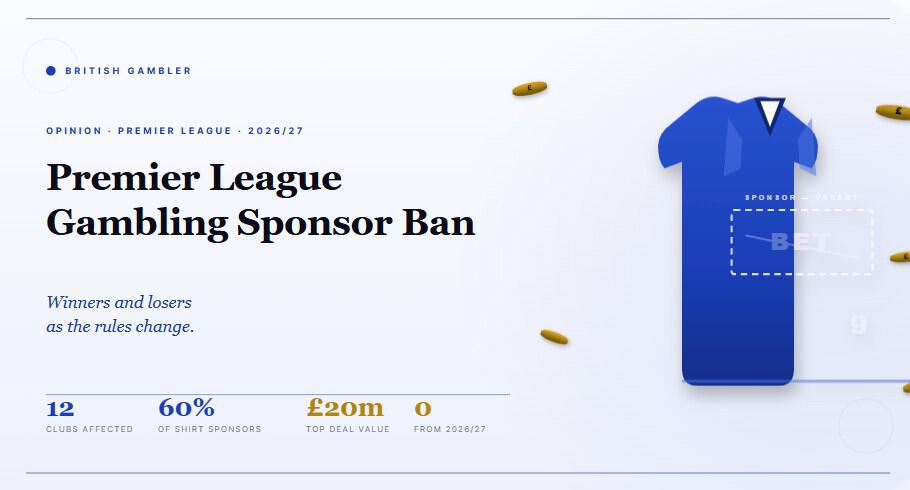
In the Premier League’s inception year, the 1992/93 season, there were no front-of-shirt gambling sponsors. Last season, there were 12, accounting for 60 per cent of the total front-of-shirt sponsorships in the division.
From the coming season onwards, however, that will drastically change, as new rules come into effect banning the use of gambling sponsors on the front of Premier League clubs’ shirts.
Each club will be impacted differently by the ban, and while some have already lined up lucrative alternatives, others are still scrambling to avoid a significant dent in income.
Aston Villa: running out of time to replace Betano
The most lucrative sports betting sponsor last season was worn by Aston Villa, who earned a cool £20 million from Betano for the privilege. With the Villans already walking a tightrope with domestic and European financial regulations, the value of money brought in from shirt sponsorship cannot be understated.
Unai Emery’s side were fined a huge £19.4 million by UEFA for “significant” financial rules breaches pertaining to the organisation’s squad cost rules.
But, just weeks away from the start of the new campaign, they are without a front-of-shirt sponsor and risk having to accept a significantly reduced fee due to shirts already being sold with no sponsor in place.
Last season, Chelsea were forced to accept a £15 million deal with IFS having only agreed a deal to become the club’s front-of-shirt sponsor until the end of the season, in February. It represented a roughly 75 per cent decrease on their initial asking price of in excess of £60 million.
Villa are the only side scrambling to replace a gambling front-of-shirt sponsor who are also in an uphill battle to comply with UEFA rules, and also the newly-introduced Premier League squad cost rules (SCR).
Everton’s pivot: from Stake to a £25m CMC Markets deal
But while Villa may be one of the most at-risk sides as a result of the ban, they were, perhaps surprisingly, not the most reliant on gambling sponsors.
Everton are no strangers to having a bright spotlight shined on their accounts, having been deducted eight points during the 2023/24 campaign for two financial breaches. Their previous front-of-shirt sponsorship with Stake was worth a reported £18 million per season. While that is less than Villa’s deal with Betano, it actually represented a higher percentage of the Toffees’ revenue.
That is the key metric to judge a club’s reliance on gambling sponsors on. A club could have the most lucrative gambling sponsorship in history, but if it only makes up a small percentage of their total revenue, the deal itself is rendered rather insignificant.
It is an important differentiation to make, because while Everton have been heavily reliant on gambling sponsors, they are actually not set to be negatively impacted by the ban.
The Merseyside outfit have already announced a lucrative new front-of-shirt deal with CMC Markets, which is worth a reported £25 million a year. Everton have also retained their Stake sponsorship, with the company’s logo instead moving to the Toffees’ sleeve, in keeping with the new rules and regulations imposed on clubs.
Which industries are replacing the bookmakers?
Over time, the sponsorship market naturally evolves. The gambling ban for front-of-shirt sponsors has brought, or forced, another drastic shift, as other sectors look to fill the lucrative void.
When the Premier League was formed, gambling sponsors were non-existent on shirts. Technology companies represented 36 per cent of all front-of-shirt sponsors in the 22-team division, while four clubs opted for alcohol sponsors.
Today, there are no alcohol-related front-of-shirt sponsors in the Premier League. There are no rules strictly prohibiting them, but clubs have trended away from them in pursuit of a more socially responsible image, since 2017 when Everton’s partnership with Chang ended.
While many clubs are yet to confirm their front-of-shirt sponsor for the upcoming campaign, there are more stemming from the finance sector than any other sector. The joint-second most common industries for front-of-shirt sponsors at present are airlines and technology companies.
A rise in airline sponsors is unsurprising given air travel’s ever-increasing popularity, with the aviation industry on track to serve more passengers in 2026 than ever before, and some four billion more than in 1992, when there were no airline sponsors in the top flight.
But where airline sponsorships are more prevalent, technology deals have seen a drastic decrease. They accounted for 36 per cent of front-of-shirt sponsors in the division, but make up just 16.6 per cent of deals announced for the upcoming season.
But, like aviation, technology is an increasingly popular industry, so a decrease in sponsorship as other areas boom feels like a significant anomaly — so why?
Many technology companies draw fierce criticism and scrutiny from the public. Whether there are questions over legitimacy, including a lack of regulation at times, or the morals behind a business.
At the top level, where such issues are less prevalent, the idea of sponsoring a football club’s shirt is less appealing. The likes of Apple, Google and Microsoft are big enough that such big-money deals offer minimal return for them. This does not stop them from sponsoring clubs generally, in the background as official partners, as Google Pixel does with Arsenal, for example.
While the nature of new sponsors remains largely unknown, it is clear that clubs’ reliance on gambling sponsors, and the size of the impact that the new ban brings with it, is huge. Some may simply have to identify and negotiate a new deal, while others face a genuine uphill battle to avoid sporting sanctions as a result.
Aston Villa are undoubtedly the most at-risk club as a result, and though their reliance on betting sponsors in recent years falls well behind clubs like Everton, how they have reacted to the rule change has far worsened their situation.
Fortunately for clubs who may be teetering on the edge of compliance, the Premier League’s new SCR rules do allow a margin of non-compliance. It subsequently reduces the threshold in future seasons, but could offer a short-term reprieve for struggling clubs as they adjust to a shift away from gambling sponsors.
Related reading on British Gambler:
- Best UK sports betting sites for 2026 — our top 10 UK-licensed bookmakers, ranked
- New to betting? – explore the bet365 bonuses for new customers