



 Jak Netting
Fact-checked by British Gambler
Spotted a mistake? Email
partners@britishgambler.co.uk
Jak Netting
Fact-checked by British Gambler
Spotted a mistake? Email
partners@britishgambler.co.uk
The population’s reliance on Artificial Intelligence (AI) is increasing week on week as tools become more powerful.
For many, they have become part of everyday life, whether it be proofreading work, planning family holidays or anything in between.
Increasingly, the primary aim of people using AI tools is to simplify and benefit their lives, whatever form that may take.
In a world where money can increasingly be made and won from the palm of people’s hands, the desire to get one up on the system is only rising.
Information released by the United Kingdom government found that gambling receipts for the current financial year are forecast to rise nine per cent to £1.78 billion, showing the ever-increasing desire to win money by the public.
Famously, there are no cheat codes for gambling, at least not legal ones. But some think they may have identified one: the rise of AI.
Need to know the weather? Ask AI. Want to find a recipe for that pasta dish you had on holiday in Italy five years ago? AI can help. So it is only logical that people would turn to the ever-evolving tools in a bid to make money.
But can AI really predict the outcome of sporting events, to help punters profit at the bookies’ expense?
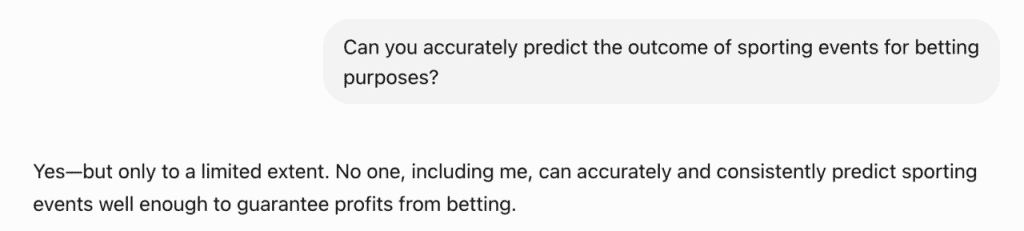
If you ask AI tools, they will tell you themselves that they cannot accurately and consistently predict sporting outcomes, and certainly cannot guarantee profits from potential betting.
The keyword there is ‘consistency’.

When put to the test, ChatGPT successfully predicted every World Cup quarterfinal scoreline within one goal of the final score – and successfully predicted all four results.
But that was the first time it was asked.

When asked again, on a different account and different device, the same AI tool, ChatGPT, gave a different and wrong score prediction.
This is largely because AI tools use “natural randomness”, as outlined by a report by Octofy, to sound less robotic and more human.
Put simply, this means that, on occasion, tools may give the second, or even third most likely answer, instead of the most obvious, to sound more human.
It also means that if you ask it the same question, on the same device and account, it will likely give you a different answer too, as it views giving an identical answer as robotic.
So when you ask AI to predict something, like a sporting event, you will not know if you have been given its most likely outcome, the second, or even the third.
Alongside this, even if you could trust that the tool is giving you its strongest prediction every time, we have already established that it does not claim to accurately predict outcomes.
This makes it a bad decision to make bets based solely on the prediction of such tools.
But that does not mean that AI does not have its uses when it comes to betting in football, among other sports.
How to effectively use AI in sports betting
The key to any good bet is research. Betting on something, or someone, you are not informed on is a rookie error, and a sure-fire way to lose money.
But research can take a long time, time which many people either do not have, or do not want to give up.
This is one of the few ways that AI tools like ChatGPT can actually prove beneficial for betting.
Given that it pulls data and information directly from the internet, it is a very powerful research tool – just ask university students!
When tools are asked to draw factual information from sources, you do not encounter the same issues of natural randomness.
It can shorten the time taken to compile in-depth research exponentially, producing near-instant results to better inform punters about what they are looking to bet on.
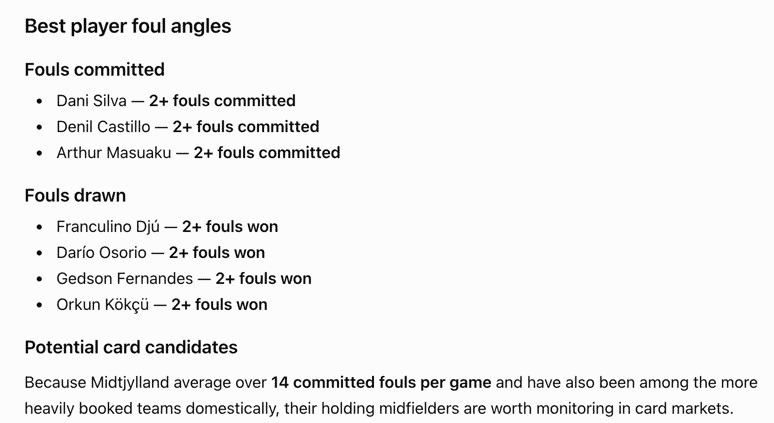
From foul and booking markets to shots and shots on target markets, it can provide accurate insight into crucial areas of gambling in just seconds.
But there is an important distinction to make. Even in this capacity, tools like ChatGPT are not serving as prediction tools; they are simply conducting research on publicly available data.
Finding value in the data
Finding data to supplement potential bets, whether aided by AI tools like ChatGPT or not, is only a small part of the battle.
The true challenge is identifying high-value bets. But, crucially, value does not automatically mean the highest potential return, as somebody new to gambling may mistakenly assume.
For example, a goalkeeper may be priced at 250/1 to score a hat-trick in any given game. With no common sense and at face value, it looks like a great opportunity to earn a cool 251 per cent profit for one bet.
But anyone with an ounce of football knowledge or common sense will realise that the hypothetical odds for that specific bet are only so high, because of the sheer improbability of it happening.
In fact, only three goalkeepers are known to have ever scored hat-tricks.
Yes, that was an admittedly exaggerated example, but the point, and subsequent lesson, lends itself to every corner of betting.
It all comes down to judgement. Value is ultimately described as picking out events where the probability of it happening is greater than the odds supplied by the bookmaker.
But, like anything, it is impossible to accurately and consistently predict. But with research, which can be efficiently aided by AI, you can give yourself a much stronger and more educated chance of getting one over on bookmakers.
Lean, but do not rely, on AI
While it is clear that AI tools like ChatGPT can have profound benefits in sports betting, there are also very apparent and evidenced limitations.
You can absolutely improve your experience and chances of success by effectively using such tools for research purposes – but expecting it to predict outcomes, no matter how large or small, is dangerous and ill-advised.
Ultimately, for many, the joy of gambling comes from the research itself. After all, the famous phrase is “When the fun stops, stop.”
So entering a robotic, automated pattern to try and find bets which will make money also makes little sense. Gambling is supposed to be fun, not a money-making method.
You can increase your chances of the latter, which can therefore lead to increased fun, but profit is by no means guaranteed and, if you are not having fun placing and tracking the bet, the negative effects of losing could feel considerably worse.
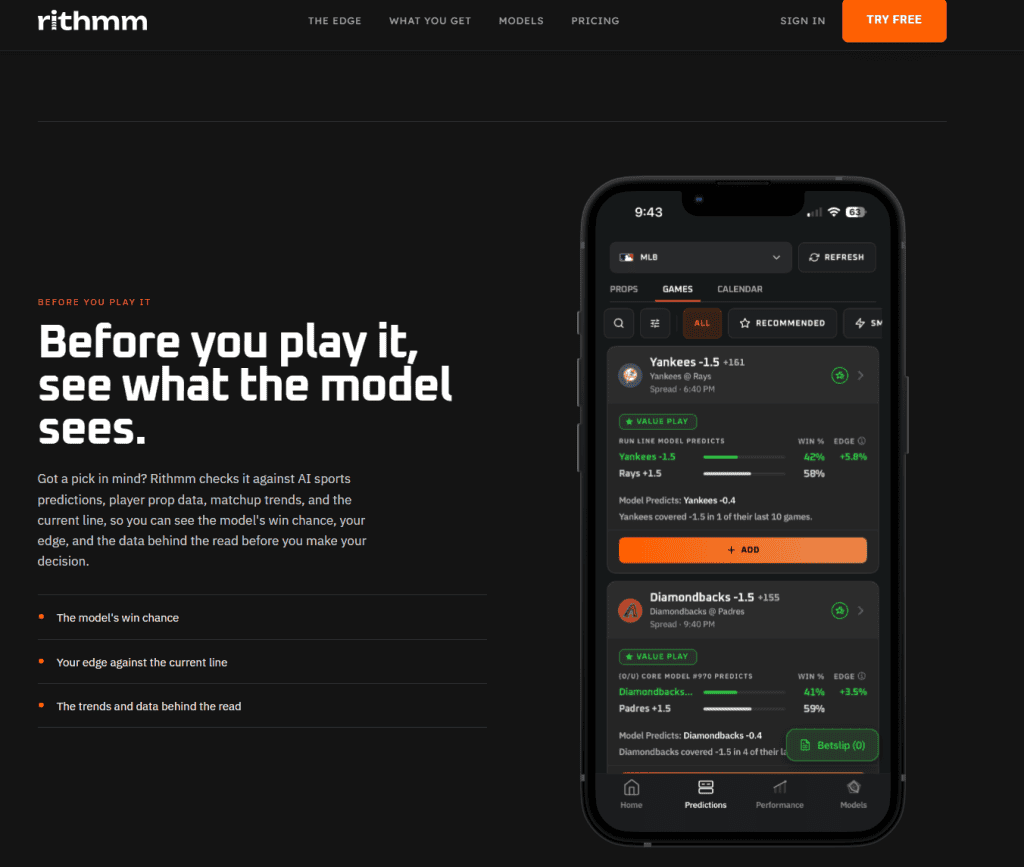
Best AI Sports Betting Tools and Prediction Platforms in the UK
Artificial intelligence is becoming increasingly popular among sports bettors looking to analyse matches, identify value bets and speed up their research. While no AI tool can accurately predict sporting outcomes or guarantee profits, several platforms use machine learning, statistical models and historical data to help bettors make more informed decisions. Here are ten of the most popular AI betting tools available to UK users.
| AI Tool | Website | Description |
|---|---|---|
| Rithmm | rithmm.com | AI-powered betting platform that lets users build personalised prediction models and analyse betting opportunities across major sports. |
| BetQL | betql.co | Uses machine learning, betting trends and simulations to estimate probabilities and identify potential value bets across football and other sports. |
| BetAlytics | betalytics.com | Advanced statistical modelling platform offering AI projections, betting simulations and probability analysis for multiple sports. |
| Leans.AI | leans.ai | AI-driven betting assistant providing predictions, trend analysis and data-based betting insights. |
| PlayerProps.AI | playerprops.ai | Specialises in AI-assisted player prop analysis using historical performance, matchup data and projections. |
| Outlier.bet | outlier.bet | Focuses on player props, line movement and positive expected value (+EV) betting opportunities using advanced analytics. |
| OddsJam | oddsjam.com | Popular value betting platform that compares bookmaker odds, identifies arbitrage opportunities and calculates expected value. |
| Unabated | unabated.com | Professional betting research tool offering fair odds calculations, market analysis and line-shopping features. |
| Props.Cash | props.cash | Research platform for player props with historical trends, filters and matchup statistics to support betting decisions. |
| Dimers | dimers.com | AI-powered prediction site using computer simulations and statistical models to produce betting projections across major sports. |
Best by category
- Best AI prediction platform: Rithmm
- Best for football and value betting research: BetQL
- Best player prop AI: PlayerProps.AI
- Best for positive EV betting: OddsJam
- Best for odds comparison: Unabated
- Best free AI prediction site: Dimers
- Best player prop research: Props.Cash
- Best custom AI models: Rithmm
- Best advanced statistics: BetAlytics
- Best AI betting assistant: Leans.AI
Remember: These AI betting prediction platforms are designed to support research and data analysis. They can help identify trends, compare odds and estimate probabilities, but they cannot consistently predict sporting results or guarantee profitable betting.
See also: top UK betting sites to use, how and which free bets to claim, and explore the newest online bookmakers we listed at British Gambler.