


The tax maths changed in April 2026 — and the brands that spent a decade as slots-only operators are now competing for your football bets. Here’s what’s really going on, and why British players should pay attention to the small print.
In the last twelve months, four UK casino brands you’d recognise have quietly added sportsbooks: Dream Vegas, Casimba, Ivy Casino (rebranded across to Grand Ivy Bet), and Lottoland. None of these are newcomers. Lottoland has held a UKGC licence since 2013. Casimba launched in 2017. Dream Vegas and Ivy Casino are slightly newer but established. All four had built their UK player bases on slots and live dealer tables — and all four decided, more or less simultaneously, that they wanted to be bookmakers as well.
This isn’t a coincidence. It’s a response to a tax change most British players have never heard of.
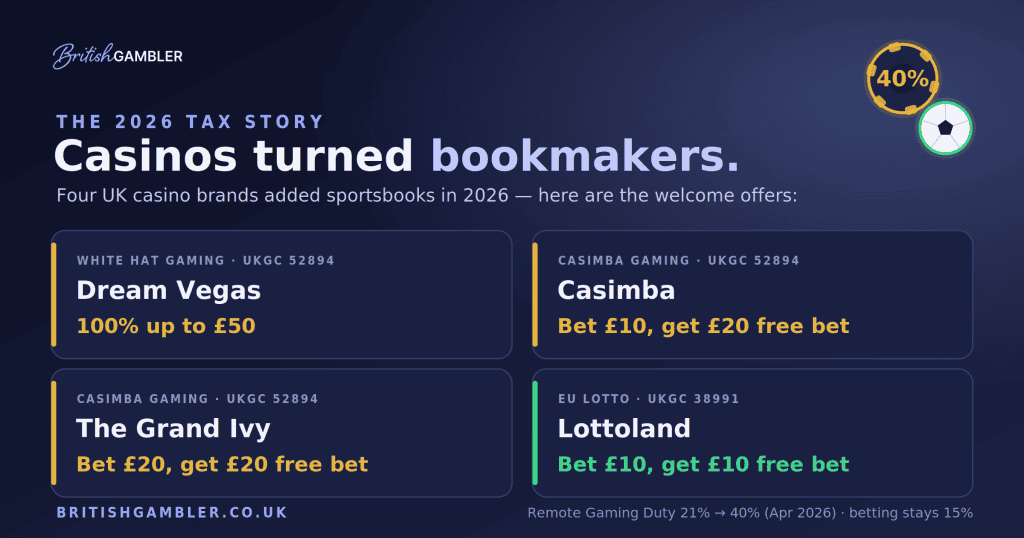
What the casinos-turned-bookmakers are welcoming new punters with
Dream Vegas Sports

Dream Vegas is a White Hat Gaming brand operating under UKGC licence 52894. The sportsbook launched in 2025 and runs on the Altenar platform — the same stack that powers sister brand 247Bet. The welcome offer is a 100% match up to £50, with a notably low 5× wagering requirement, minimum odds of 1.75 (3/4), and a 30-day expiry on bonus funds. The product covers more than 40 sports, with football across dozens of countries; bonus funds can be used on any sport except virtuals, boosted odds, handicap and draw-no-bet markets.
The genuine differentiator is the single-wallet loyalty system: sports bets and casino spins both feed the same My Vegas points balance, the Daily Vegas Perks reward stream, and a £30,000 annual prize draw. For crossover punters this is unusual — most casinos that bolt on a sportsbook gate the loyalty programme to slots only.
Casimba Sports
Casimba is the flagship of Casimba Gaming, founded in 2017 as a casino-only brand. The sportsbook launched in early 2026 — nearly a decade after the casino, which tells you how long this brand resisted the move before the maths changed.
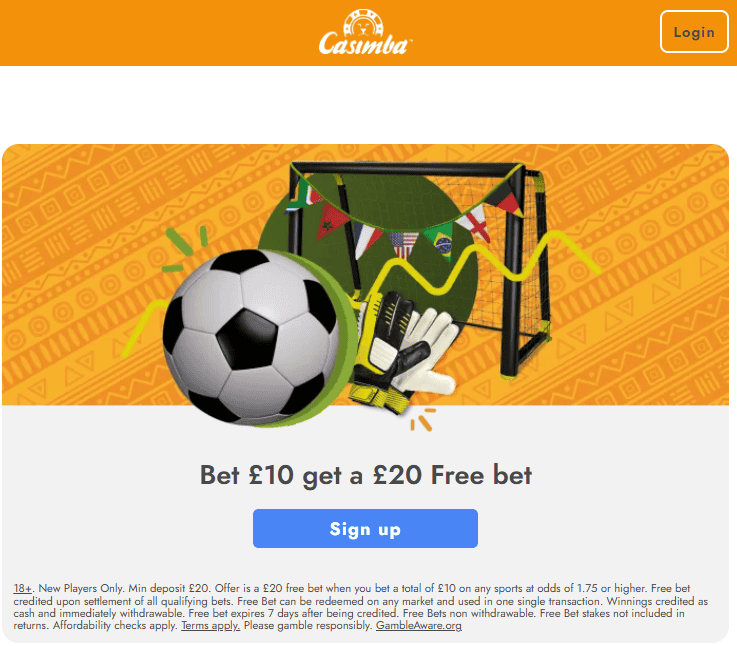
The current welcome offer at this new UK sportsbook is Bet £10, Get a £20 free bet: bet a total of £10 on any sport at odds of 1.75 or higher (minimum deposit £20), and the £20 free bet is credited once your qualifying bets settle. It can be used on any market in a single transaction, winnings are paid as cash and are immediately withdrawable, the free bet expires 7 days after being credited, and the free-bet stake is not returned in winnings.
Casimba’s sportsbook runs on Altenar — the same platform as Dream Vegas and as Casimba Gaming’s standalone sports brand 247Bet (which launched in 2025 under White Hat Gaming’s UKGC licence). The casino side carries 2,400
Grand Ivy Sports

Here’s where the “four separate brands” story breaks down. The Grand Ivy is operated by White Hat Gaming Ltd and owned by Casimba Gaming, under the very same UKGC licence — 52894 — as Dream Vegas and Casimba. Its casino has run since 2016; the sportsbook was added in spring 2026, again on Altenar. In other words, three of the four brands in this article share one licence, one platform provider and, broadly, one corporate stable.
The welcome offer is Bet £20, Get a £20 free bet: deposit and stake £20 in a single transaction on any sport at odds of 1.75 or higher, and a £20 free bet is credited once the qualifying bet settles. As with Casimba, it’s redeemable on any market in one transaction, winnings are cash and immediately withdrawable, the free bet expires after 7 days, and the stake isn’t returned. The sportsbook spans roughly 36 sports and eleven esports with Bet Builder support, average margins around 6%, plus casino-style extras like a daily Bonus Wheel, Acca Boosts and the group’s £30,000 prize draw.
+1: Lottoland Sports
Lottoland Bet is the genuine outlier — a different operator entirely. It’s run by EU Lotto Limited under UKGC licence 38991, founded in 2013 as a lottery-betting platform (and famous for a €90 million jackpot payout in 2018, certified by Guinness as the largest online gambling win). Lottoland added a sportsbook back in 2019, well before this casino-to-sportsbook wave accelerated. The welcome offer is Bet £10, Get £10 in free bets: the qualifying bet must be an accumulator or Bet Builder with 2+ selections at minimum combined odds of 3/1 (4.00). The free bet expires 7 days from claim, can’t be cashed out, and winnings are capped at £100.
In depth: explore the best UK online casinos, read reviews and learn about their offerings.
Here is an updated list of the latest online sports betting platforms.
The tax change that’s driving all of this
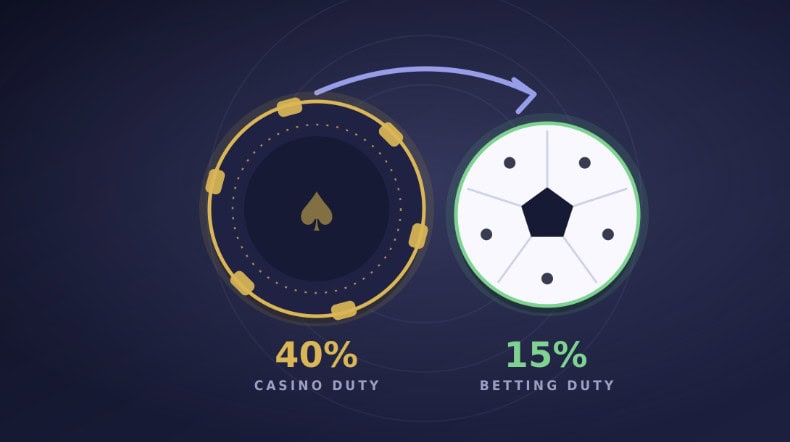
Here’s what almost no operator will say out loud. The UK’s Remote Gaming Duty — the tax operators pay on online casino revenue — rose from 21% to 40% on 1 April 2026, following HM Treasury’s Autumn Budget 2025. At the same time, the duty on online sports betting stayed at 15%, with a new 25% remote betting rate scheduled for 1 April 2027 (and bets on UK horse racing, plus self-service terminals, spread betting and pool betting, excluded from that rise — they stay at 15%). Bingo Duty was abolished entirely from April 2026.
Translate that into operator economics:
- For every £1 of casino gross gaming revenue, the operator now pays 40p in duty.
- For every £1 of sports betting revenue, the operator pays 15p until April 2027, then 25p.
In other words, sports betting is currently taxed at well under half the rate of casino — and even after the 2027 rise, betting will remain the lighter-taxed product. The Office for Budget Responsibility expects operators to pass on up to 90% of the duty increase through worse odds or lower payouts. For a brand already sitting on a UKGC licence and a player database, bolting a sportsbook onto an Altenar or Delasport platform looks very different in April 2026 than it did in March.
British Gambler’s take: why we think this is really happening
The mainstream affiliate explanation is “tax.” That’s part of it — but it isn’t the whole story.
The full story, in our view, is the acquisition funnel. A sportsbook is now a cheaper, lower-margin product to run — but it’s a fantastic top-of-funnel hook. Sports betting attracts a broader demographic than slots: more men aged 25–45, more first-time gamblers pulled in by World Cup 2026 or Premier League fixtures, more people who’d never call themselves “casino players.” A 100%-up-to-£50 sportsbook welcome like Dream Vegas’s is a cheaper customer-acquisition cost than a casino welcome of equivalent perceived value, because the sportsbook bonus burns through smaller wagering and lower house edges.
Once those players are inside the wallet — particularly with single-wallet structures like Dream Vegas’s My Vegas points — the operator can cross-sell into casino. And casino, despite the 40% duty, is dramatically more profitable per active player than sport. House edge on slots typically runs at 3–8%; sportsbook margins on these brands (around 6%) sit lower than the loosest slots.
So the strategy looks like this: acquire the customer with a sportsbook offer, retain them with casino. The established brand name — Casimba, Dream Vegas, The Grand Ivy, Lottoland — does the heavy lifting on trust. The sportsbook widens the audience beyond the slots-only crowd. And the casino product, sitting in the same wallet, becomes the profit engine. That three of these four brands run on a single shared licence and platform only underlines how deliberate and repeatable the playbook is.
It’s also why the UKGC’s 2026 ban on cross-product promotions matters more than the affiliate market has acknowledged. The regulator clearly saw this coming and made it harder to funnel customers between products with stacked bonuses. The operators’ response has been to design single-wallet experiences and unified loyalty programmes that achieve the same outcome through structure rather than promotion.
What this means for British players
Three things worth knowing:
1. The bonus terms are generally better. With the 10× wagering cap in force since January 2026, even the casino-side bonuses from these crossover brands are cleaner than the 30×–50× regime of 2024. Dream Vegas’s 5× sports wagering requirement is genuinely competitive — most established sportsbooks sit at 1× to 5×, so the casino-led brands are competing on terms, not just headline numbers. For the full picture on how the cap reshaped these offers, see our best casino bonuses guide.
2. The product is often shallower than the casino side. Dream Vegas has no native sports app; Casimba’s and The Grand Ivy’s sportsbooks are good but new, and — being White Hat/Altenar stablemates — share much of the same underlying sports product. If you want best-in-class in-play, racing or Bet Builder coverage, you’ll still get more from a pure sportsbook like bet365 or Betfred. For welcomes from operators built around betting from the start, see our betting sites hub. These brands give you “good enough” sports — and serious casino.
3. Watch the single-wallet structure. If you’re a sports-first player who occasionally plays slots, a single-wallet brand like Dream Vegas can compound your loyalty value across both. If you’re a slots-first player who occasionally bets the FA Cup, the structure is harmless. But if you’ve been managing your gambling by playing only sports and deliberately staying off casino, be aware: these brands surface casino content within the same logged-in session and the same balance. That’s a deliberate product-design choice, and it’s worth knowing before you opt in.
Fact summary
What happened: four established UK casino brands (Dream Vegas, Casimba, The Grand Ivy and Lottoland) added sportsbooks between 2019 and 2026. The stable: Dream Vegas, Casimba and The Grand Ivy all operate under White Hat Gaming / Casimba Gaming on UKGC licence 52894, on the Altenar platform; Lottoland (EU Lotto Limited, UKGC 38991) is the independent outlier. When the tax changed: Remote Gaming Duty rose from 21% to 40% on 1 April 2026 (HM Treasury Autumn Budget 2025); the online betting rate stays at 15% until 1 April 2027, when it rises to 25% (UK horse racing, SSBTs, spread and pool betting excluded). Where to check the rule: HM Treasury Autumn Budget 2025 / gov.uk and the UK Gambling Commission for licensing. For ongoing coverage, see our news section.
British Gambler covers the UK regulated gambling market for players aged 18 and over. Offers and terms change frequently — always check the operator’s current terms before depositing. If gambling is affecting you or someone you know, free, confidential support is available 24 hours a day at GambleAware.org or on the National Gambling Helpline, 0808 8020 133. Always gamble responsibly.